Route Optimization With Time Windows (VRPTW)
Time windows are one of the most important real-world constraints in route optimization.
If customers require service within specific hours, your route optimizer must create a schedule that arrives on time
while still minimizing distance and travel time.
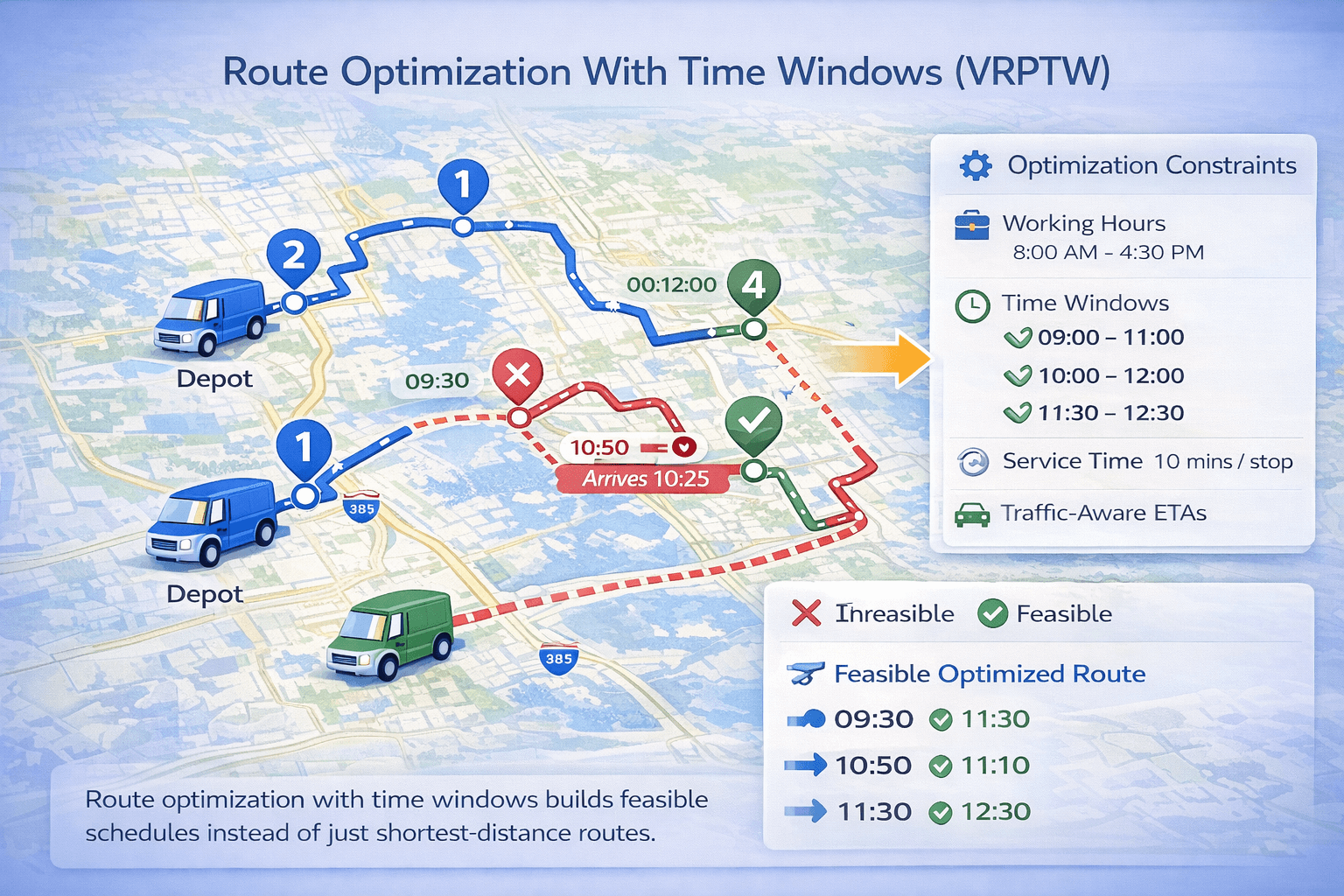 Route optimization with time windows ensures arrivals happen within allowed time ranges, even if the shortest route is infeasible.
Try Time Window Routing in TrackRoad (Free)
Add stops, set time windows, and optimize routes instantly with multiple vehicles, capacity limits, and working hours.
Optimize Routes Now
Complete Guide
1) What are time windows in route optimization?#
A time window is the allowed time range when a stop can be visited.
For example:
- Stop A: 9:00 AM – 11:00 AM
- Stop B: 12:00 PM – 2:00 PM
- Stop C: 3:00 PM – 5:00 PM
The route optimizer must create a schedule that arrives inside these ranges while still producing efficient routes.
If you’re new to route optimization, start here:
What is route optimization?
and
How route optimization works.
2) Why time windows matter for delivery and service routes#
In the real world, customers are rarely available “any time.” Most deliveries and service visits have scheduling requirements.
Time windows protect customer satisfaction and help your business operate smoothly.
Industries where time windows are essential
- Food & grocery delivery — scheduled delivery slots
- Medical delivery — strict drop-off windows for labs/hospitals
- Retail replenishment — stores accept deliveries only at certain times
- Field service — appointments booked with customers
- Courier / same-day — pickups and deliveries with deadlines
Without time window optimization, dispatchers often route manually, which causes late deliveries, overtime, and unnecessary miles.
3) Hard vs soft time windows#
Hard time windows
A hard time window means the stop must be visited inside the window. If arrival is late or early,
the route is invalid.
Soft time windows
A soft time window allows arrival outside the window, but the system applies a penalty
(for example: a cost per minute late). This is useful when punctuality matters but violations are sometimes acceptable.
4) What is VRPTW?#
VRPTW stands for Vehicle Routing Problem with Time Windows.
It’s a classic optimization problem where each customer must be visited within a defined time window.
VRPTW is harder than standard routing because it reduces flexibility and often creates tradeoffs like:
- More driving distance to meet deadlines
- Waiting time when drivers arrive early
- More vehicles required to satisfy all time windows
- Infeasible routes when windows are too narrow
5) How time windows change route optimization#
Without time windows, an optimizer mostly focuses on minimizing distance or time.
With time windows, the optimizer must build a schedule — not just a route.
The optimizer evaluates:
- Travel time between stops
- Service time at each stop
- Arrival time schedule
- Waiting time (arrive early)
- Feasibility of reaching each stop before its deadline
This is why time windows often change the “best route” completely — it may not be the shortest distance route,
but it’s the route that arrives on time.
6) Waiting time and service time#
Time windows create an important concept called waiting time.
If a driver arrives before the window opens, the driver must wait.
Example:
- Stop opens at 10:00 AM
- Driver arrives at 9:40 AM
- Driver waits 20 minutes
Waiting time matters because it can reduce the number of stops a driver can complete within working hours.
Service time is also important. If a stop takes 10 minutes to complete,
it must be included in scheduling.
7) Real-world examples of time window routing#
Example A — Home delivery
A customer requests a delivery between 1:00 PM and 3:00 PM.
Your optimizer schedules this delivery inside that window.
Example B — Retail store deliveries
Store deliveries are accepted only before 10:00 AM.
The optimizer prioritizes those stops early — even if it means extra miles.
Example C — Medical courier
Lab pickups must happen before a strict cutoff.
Time windows help guarantee compliance and reduce missed pickups.
8) Time windows with multiple vehicles#
With multiple vehicles, time windows impact both:
- Stop assignment — which vehicle should do which stops
- Route sequencing — stop order inside each assigned route
TrackRoad supports multi-vehicle optimization with time windows, capacities, and working hours.
Learn more here:
Route optimization with multiple vehicles.
9) Common mistakes that break time-window routing#
Mistake 1 — Windows are too narrow
If your time windows are extremely narrow (for example 10 minutes),
the optimizer may be unable to satisfy them.
Mistake 2 — Not including service time
If a stop takes 15 minutes to complete but you don’t set service time,
your schedule will be unrealistic.
Mistake 3 — Working hours are too short
If vehicles have limited working hours, and time windows force waiting time,
the route may become infeasible.
Mistake 4 — Too few vehicles
Time windows sometimes require more vehicles than a “no time window” plan.
Otherwise your routes may not finish on time.
10) Best practices for delivery time windows#
- Use realistic windows — 30–120 minutes is common for delivery slots
- Always set service time — unloading + paperwork takes time
- Use multiple vehicles when needed
- Test scenarios — optimize routes with and without windows to see impact
- Track execution — use driver apps to confirm real arrival times
If you want to compare routing approaches, see:
Route planning vs route optimization.
11) How TrackRoad supports time window optimization#
TrackRoad allows you to:
- Add time windows to each stop
- Add service time per stop
- Optimize routes with multiple vehicles
- Respect driver working hours
- Generate ETAs and route schedules
- Send routes to drivers using iOS and Android apps
- Track visits and completion status
12) FAQ#
Can route optimization work if some stops have no time window?
Yes. Stops without time windows are treated as flexible and the optimizer schedules them around constrained stops.
What happens if a route cannot satisfy all time windows?
The optimizer may split stops into multiple routes, require more vehicles, or mark the route as infeasible.
You may need to adjust time windows, increase vehicles, or expand working hours.
Is VRPTW harder than normal routing?
Yes. Time windows reduce flexibility and increase complexity, which is why route optimization software is needed for realistic scheduling.
How much can time windows increase route cost?
It depends on how strict the windows are. Narrow windows can increase waiting time and require longer routes or more vehicles.
Many teams still benefit because meeting windows reduces failed deliveries and improves customer satisfaction.